The work, in the order it had to happen
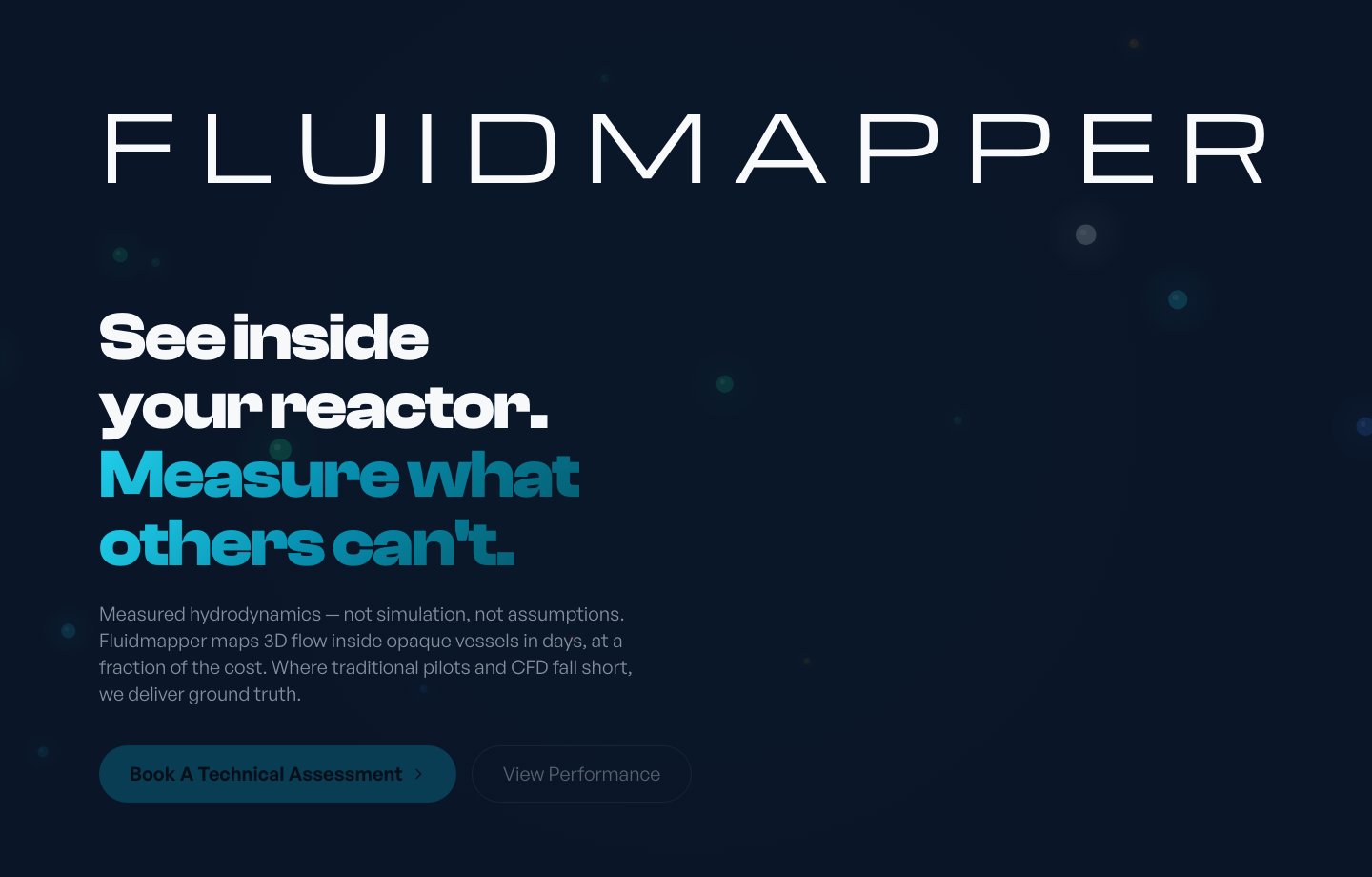
1. Build the brand from the science. Known: a real, hard-to-copy capability, told the way a paper tells it. Unknown: what a buyer needed to hear first. The question was what the science means to someone who will never read the paper. It produced the brand system, with the positioning, palette, type, logo system and tagline; a sales deck rebuilt from the academic one, every technical diagram redrawn for a buyer; and a two-page pitch. The company's own deck and where each of its ideas went are side by side in Attachment G. Then the public site at fluidmapper.com, designed and built by Common Ground in English and French, with a booking flow and the discovery program as the way in. Its performance page carries the measured accuracy, and its case studies put each result under the engineering question it answers. It turned a lab with a result into a company with a front door.

2. Price the offer, and never publish the price. Known: the founder had already designed a discovery program, a setup fee paid once for geometry preparation, tracer activation and calibration, with the first measured datasets included. Unknown: whether it funded itself or was a disguised giveaway. It was restructured as a flat setup fee sized to the real cost of onboarding a vessel, per-run pricing that declines with commitment as a deliberate concession rather than a cost curve, and every tier set to land under the threshold at which the buyer's own organization requires management sign-off. That trades margin for procurement speed while the company still needs its first reference accounts, and it should be retired once it has them. A pricing page was built and then pulled, on purpose. A PhD buyer needs to know whether his vessel, fluid and temperature range even qualify before a number means anything, and a published price for a non-commodity capability reads as a commodity claim.
3. Plan the growth, and write the first version of the sales process. Known: a brand, a site and an offer. Unknown: how a stranger would become a customer. In April the founder asked for a campaign and marketing plan, and the strategy session that answered it covered positioning against simulation, the file-format hook, search and the economics of conferences. He also wanted buyers to be able to quote and order on their own, so I scoped a self-serve quote-and-order portal into build paths with the trade-off on each. Then the booth: banner, table topper and print files for the mixing industry's conference, where the company held a gold sponsor slot. The sales process at that point was the founder, a site and a booth. It worked well enough to bring home real leads, which is what exposed the next problem.
4. Fence the numbers that were not measured. Known: the founder's deck carried hard, measured figures on position repeatability, sample counts and sampling rate. Unknown: which of the softer numbers circulating in slides, cost-reduction percentages and case-study savings, a range as wide as 80 to 95 percent, were measured, modeled or simply asserted. The question was not whether a number sounded good but whether it sat in a primary source. It produced a claims file that split every figure into a confirmed column and an unconfirmed one, with the unconfirmed figures fenced off from external use until he ratified them against a source. Nothing was deleted. Every flyer, page and proposal since draws only from the confirmed column, which is why the collateral could ship without a second technical review.
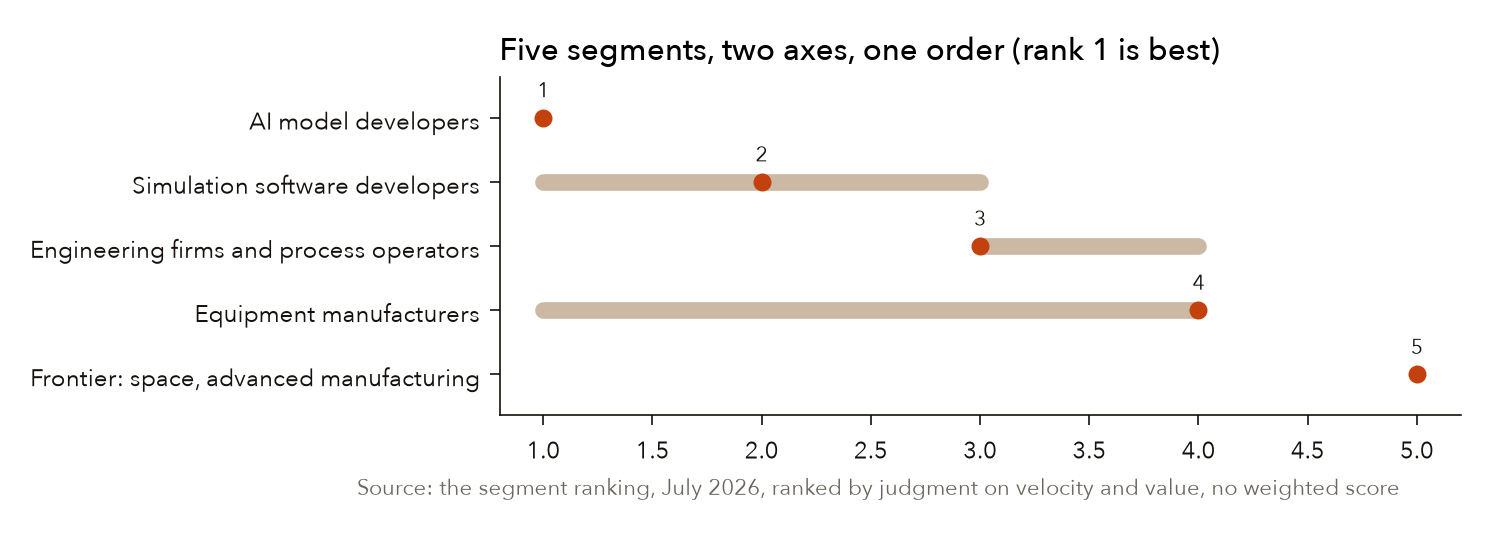
5. Rank the buyers before the collateral. Known: the founder's own one-pager named five segments, equipment manufacturers, engineering firms and process operators, simulation software developers, AI model developers, and a frontier tier of space and advanced-manufacturing accounts. Unknown: which would move fastest and pay soonest. I ranked them by judgment on two criteria kept separate, velocity, how fast a lead becomes a paid engagement, and value, what the account is worth once it converts, and refused to multiply them into a score neither one can produce. No segment won on both. AI model developers ranked second on each axis and first overall, because their hunger for measured training data makes the raw output the product they are buying rather than a validation step. Simulation software ranked first on velocity, through the warm sponsor relationship, and I put it second. That is a checkable trade, value over speed, made on incomplete evidence. It changed the outreach order: warm seeds inside each segment before any cold name, and the AI segment ahead of the mixing-and-reactors buyer a company built by process engineers would reach for by default. The segment worksheet is Attachment C.
6. Review the site's sales plan into one narrative. Known: five segments with five buying triggers. Unknown: whether the site should mirror that with separate paths or collapse them. The fastest way to find out was to draft it. The first plan, one funnel page per buyer type behind a router that asked "where do you fit," was built from his own segmentation. A structured review, reading with a sales lens and a simplicity lens, converged on one call. The four voices were real and the four pages were not serving them: the same evidence divided four ways left each page with a thinner case and no room to answer the radiation-safety and intellectual-property question before a competent reader hit it. The second plan led with plant operators, the buyer with the most legible problem, put the safety and IP answer in the first screen, named the discovery program as the entry point without a number, gated a sample report behind an email and ended on one fit call instead of four. The site leads with operators while the outreach leads with AI developers, and that is deliberate: a cold visitor has to recognize the problem before anything lands, while outreach goes to a named, already-warm segment. The block-by-block comparison is Attachment D.
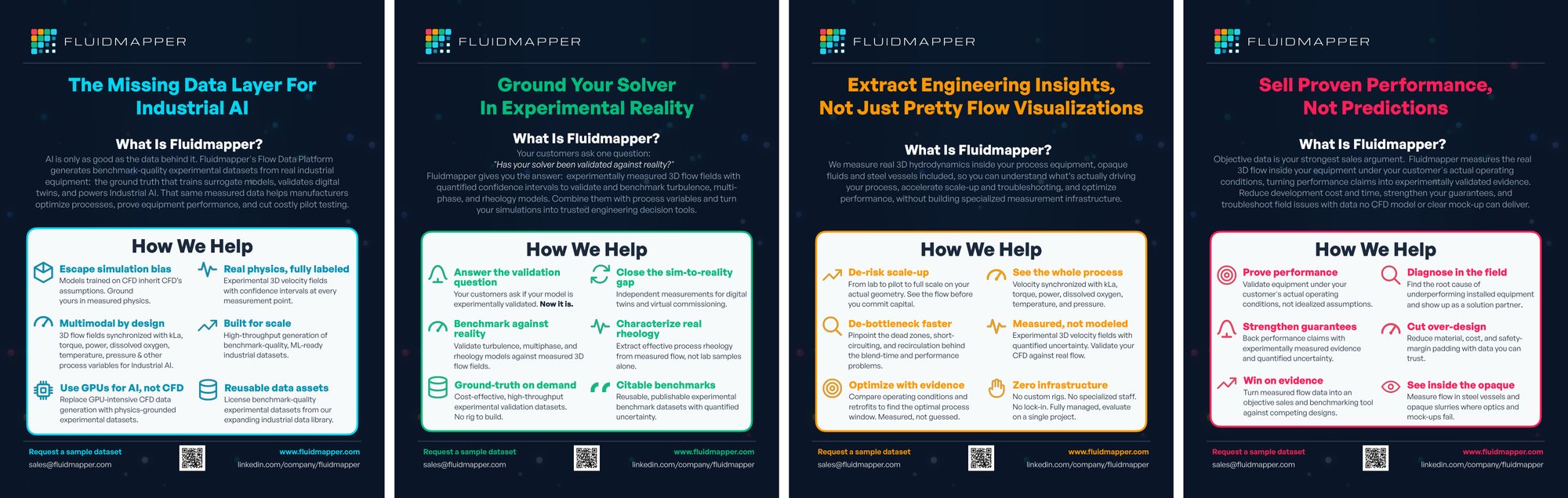
7. Lead with the file, not the accuracy. Known: two of the ranked segments, simulation software and AI, live inside simulation output. Unknown: what would make an engineer in those lanes lean in. The founder had seen it, and so had a leader at one of the industry's simulation companies, separately and months apart: a simulation engineer can open Fluidmapper's measured result in his own tools, in the same file format as his own simulation, with no conversion and no custom parsing. That became a headline section on the software flyer instead of another accuracy figure. The four vertical flyers shipped in August next to a target brief that researched named companies across the ranked segments and sorted the warm leads into three buyer types: equipment makers who must defend a performance spec, venture-backed frontier companies whose thesis rests on a physical claim nobody has measured, and physics-AI companies trained on solver output who need a held-out set of real measurements. Outreach stopped depending on one introduction. The four flyers are Attachment F.
8. Build the proposal system so he signs instead of drafts. Known: by late August the first named accounts needed offers, and the company had no repeatable way to turn a technical conversation into a signable statement of work. Unknown: whether one template would hold across account types. I built it on the shape of an enterprise statement of work: scope in vessel-and-fluid terms, deliverables stated the way a software contract states them, a timeline dated from signature on the day-scale cycle the technology actually runs on, assumptions that protect both sides, commercial terms from the scoped conversation, one signature block, and a credibility appendix drawn only from the confirmed column. The first editable file was rejected because his brand fonts did not survive into the format his own team would hand-edit, and the fonts were repaired inside the file before it was called done. The structure is Attachment A. The first proposals went out on it in September.
9. Reposition around physical AI, and go find the other AI buyers. Known: the definition of the AI buyer had already moved three times, from one line in his segment list, to the top of the ranking, to the Industrial AI language the August flyers locked in. By September the category had renamed itself, and the founder was hearing "physical AI" in live conversations. Unknown: whether the company's argument survived the new frame. It did, and it got sharper. Physical AI money is going into world models, and the first ones were aerodynamic, because air barely changes and a model validated against experiment once carries across cases. Fluids break that. Phases, bubbles, solids, impurities and crystallization each make a new regime, so a fluid model needs continuous measured grounding, and the fluids that matter are opaque, where optical methods fail. So the company is not a physical AI company. It is the measured-data layer under one. The segment became Physical AI companies, simulation software stayed its own lane, and every measurement limit came off the collateral, because scope is a conversation with the founder, not a filter on a page. Then we went looking past the obvious names, into world-model builders, AI trained on simulation, industrial process AI, bio and pharma labs that are automating, and the platforms whose customers are the buyer. The argument and the buyer map are Attachment B.
Physical AI companies just need physical truth. Everything in that world is trained on simulation, and simulation is a model of a thing, not the thing.
10. Build the sales team around the founder. Known: a brand, a ranked market, an offer, a proposal system and a sharper argument, all still resting on one seller. Unknown: whether anyone else could carry the first conversation. This was the break point of the whole engagement, and it was a people problem, not a marketing one. I built out the sales side and found a full-time salesperson, so the founder is no longer the first voice a buyer hears. Outreach now runs in three voices, kept separate. Mine is the connector: never a pitch, never naming who the introduction is to, never naming a mutual, never quoting a funding round or a company's own website back at them. The seller leads with the buyer's problem and keeps the numbers for the second message. The founder is the physics, and takes anyone whose first reply is a technical test. The rules live in the tool that builds each day's list, not in anyone's memory: at most two people per company, nobody already connected to the founder, and any account the company is already working held out as a class, because a cold note into a relationship the founder is personally working cuts across the one conversation closest to closing. LinkedIn, not email, because the technical buyers worth reaching treat cold email at volume as spam. Our own AI tooling does the research and the checking; a person writes every note. Earlier in the year we had run an automated cold-email campaign of our own, under my name, and stopped it, because it could not pass as a person and I was not going to put a founder's name on copy that could not pass as his. The warmest early answer came from a founder who builds simulation software, who wrote that measured fields inside an opaque vessel are the only thing that team cannot generate itself. It is now a daily practice, across the other verticals.
What came of it
The contracts on the cover closed after the engagement began. The gold conference slot became membership in NVIDIA Inception. The proposal system carried the first proposals out in September, and the founder can produce the next ones himself. The company now has a seller in front of it, and it now describes itself to AI buyers as a data company, which is what it is.
Which segment each contract came from is the fact that would test the ranking in step five. The contracts are confidential, so I do not print it here, and the order stands as a defensible judgment rather than a validated one. I would rather say that plainly than let a reader assume the money proved it.
What we kept, what we replaced, what we installed
Kept. The founder's own five segments; the ranking reordered them and did not replace them. His discovery program, which became the revenue instrument instead of a goodwill gesture. His measured figures, which are the only numbers that appear anywhere.
Replaced. The academic deck, with a sales deck and a two-page pitch. The four-funnel plan, with one narrative. Automated outreach, with notes written by hand in each voice.
Installed. The brand system and the public site. The claims file. The proposal system. The ranked target brief. A sales team, with a full-time salesperson, a daily outreach practice and the rules built into the tool that runs it.
The process touched, and who put it there. The flyer-first instinct was the founder's, and the four-funnel plan was ours, built from his segments, and both were reasonable: conferences were producing leads, and five distinct buyers with five distinct triggers should on paper get five front doors. What was faulty sat upstream of the collateral. The leads had no named buyer, and the plan split one argument across four pages so that no page carried the whole case. Underneath both was the older habit of a founder-led science company, where the founder is the whole sales process. It had to change then, not later, because the sponsor relationship and the Inception program were opening doors that a room-facing pitch would waste, and the one person who could walk through those doors could not also be drafting every document behind them and making every first call.
What it cost to hold the line, and what I watch
Ranking one segment first means the others wait, including the industrial buyer this company's own roots would reach for, and waiting is a real cost if the order turns out wrong. Pricing under an approval threshold buys speed with margin, and it sits in some tension with the moat argument: a capability this scarce should in principle price on value, not slide under a signature limit. The trade was right at pre-revenue, and it has an expiry, which is the first thing I would revisit once a named reference customer exists. The site still rests on one anonymous case study. A named customer with one line of quote is worth more than any funnel variation, and that is a sales lift, not a design lift.
The thing to watch in the outreach is the contact file, not the copy. When we opened every profile we had not yet checked, a real share of the rows were wrong: titles had changed, people had left, and some profile addresses on file pointed at a different human being entirely. A send on one of those rows goes to a stranger. Verification now lives in the tool, and it removes a row with a printed reason instead of dropping it quietly.
The constraint I moved but did not remove is the founder himself. The seller now takes the first conversation, the proposal system took drafting out of his week and the target brief took the dependence off one introduction. He is still the only person who can hold the deepest technical conversation, and nothing I built replaces him. That is the honest state of a founder-led deep-tech company at this stage, and the work was to point his hours and put a seller in front of him, not to pretend his hours were unlimited.
What it produced
The contracts on the cover closed after the engagement began. The gold conference slot became membership in NVIDIA Inception. The proposal system carried the first proposals out in September, and the founder can produce the next ones himself. The company now has a seller in front of it, and it now describes itself to AI buyers as a data company, which is what it is.
A slice of the project list
A few related projects.
- Alice Mushrooms: go-to-market and brand advisory as the company moved from direct to consumer into national grocery and mass retail (2022 to 2026)
- Lip Loi Creative: fractional CRO and go-to-market strategy for a creative studio, sourcing and directing the engagement roster (2022 to 2026)
- Ink Games: go-to-market strategy and a seed-stage capital raise run with our capital partner through Prince Capital (2019 to 2020)
- Xtrata Consulting Seat: fractional CRO and construction consultant, a bid system of record and a pricing doctrine (2025 to present)
- Sublime Medical: fractional COO seat for a cosmetic dermatology group, tracing a collections problem to its root cause (2015)